AI Problem Framing for AI Practitioners
Operating assumptions
Alternatives
Trade-offs
Signals
Over the last few years I've worked hands-on with more than a hundred AI use cases across enterprise, startups, and research. Almost none of the failures were failures of the model. Someone had chosen the wrong problem, or defined success so loosely that nobody could tell we were solving it wrong.
This book is about that framing layer: how to frame the problem before you build, how to tell whether it's working once it runs, and when to change course.
What's inside
The book is in two parts. Everyone reads Part 1, the method, in order. Part 2 is a reference you dip into for your kind of system: an ML practitioner can go straight to ML diagnostics and an agent builder to trajectories.
| Chapter | What it covers | |
|---|---|---|
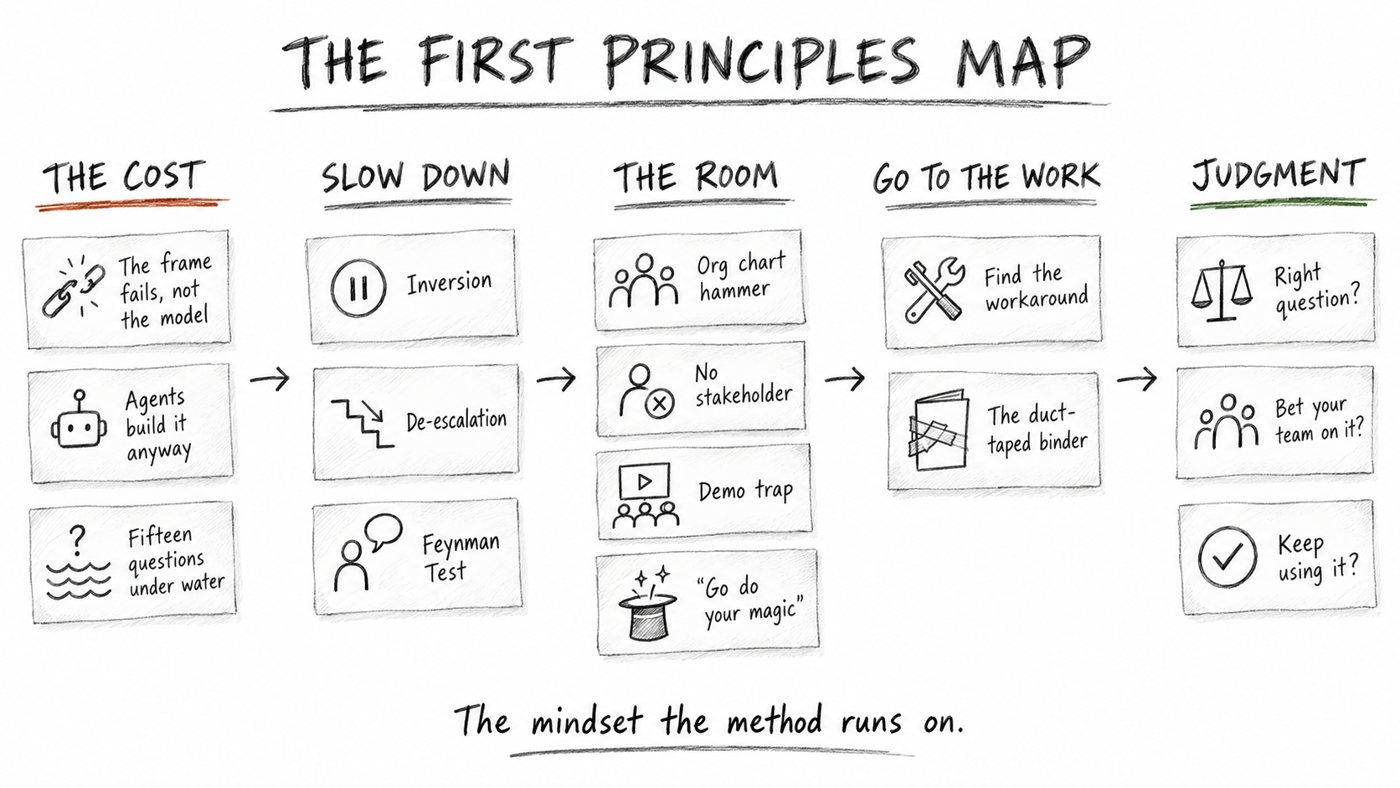
| 1 | First Principles | What bad framing costs, why it's hard to see from the inside, and three thinking techniques that catch it. |
| 2 | Framing the Agent Task | The GOATS Loop end to end: Goal, Operating Assumptions, Alternatives, Trade-offs, Signals. |
| 3 | Knowing If It's Working | The diagnostic tests for a running system: is there signal, is it cheating, is the metric real. |
| 4 | The Decision Point | When to persist, pivot, or stop, the five reframing moves, and how to communicate the call. |
| Part 2 | Diagnostics in Depth | General diagnostics first, then ML, GenAI and RAG, and agent sections. |
| Appendix | The four artifacts | The Framing Brief, GOATS One-Pager, Diagnostic Readout, and Decision Memo, each filled in for the project the chapters follow. |
How to read it
If you finish a chapter feeling slower, less confident, or a little annoyed, you're doing it right. The instincts that got you here are trained on years of "I've seen this before, I know what to build." That pattern matching is fast and usually right, but AI keeps producing problems that look like ones you've solved before and aren't.
This book isn't a coding guide. The how is well served elsewhere, by frameworks, vendor docs, and the long tail of AI tutorials that appear every week.
Pair it with the skills
This edition comes with two free skills you run on your own project. frame-use-case walks the framing before you build, and diagnose-use-case runs the diagnosis once the system is live. Either one drafts the whole frame in minutes. What a skill can't do is the judgment: it can't tell you whether your 75% target is ambitious or sandbagged, and it's trained to agree with you more than a skeptical colleague would. That judgment is what the chapters teach.
Sharing and citing
The book is licensed CC BY-NC 4.0. You're free to share and adapt it for non-commercial use, in any medium, as long as you credit Rajiv Shah and link to aiframer.dev.
If you want the short version of the argument first, read why framing matters. The thinkers the method borrows from are on the influences page.